
Short answer: yes, and after 60 it is one of the best things you can do with an hour. Pilates makes older adults measurably steadier, stronger and more mobile, and it gets there without asking you onto the floor or under a barbell. A private session matters more at 70 than at 40, because the gap between two people of the same age is enormous.
Your first private session is free, with no conditions. One instructor, one client, a full hour.
Most people who come to me in their seventies do not open with a fitness goal. They open with a moment. A grab for the handrail that felt closer than it should have. A chair that took two attempts. A trip on a curb that ended fine and then stayed in their head for a week.
What they want is not to get into shape. It is to stop noticing their own body during an ordinary day.
My background is physiotherapy. I worked in it for more than ten years before I trained in the classical Pilates method, and that background is the reason I start with how someone moves rather than with a list of exercises. Age on its own tells me almost nothing about what a person can do.
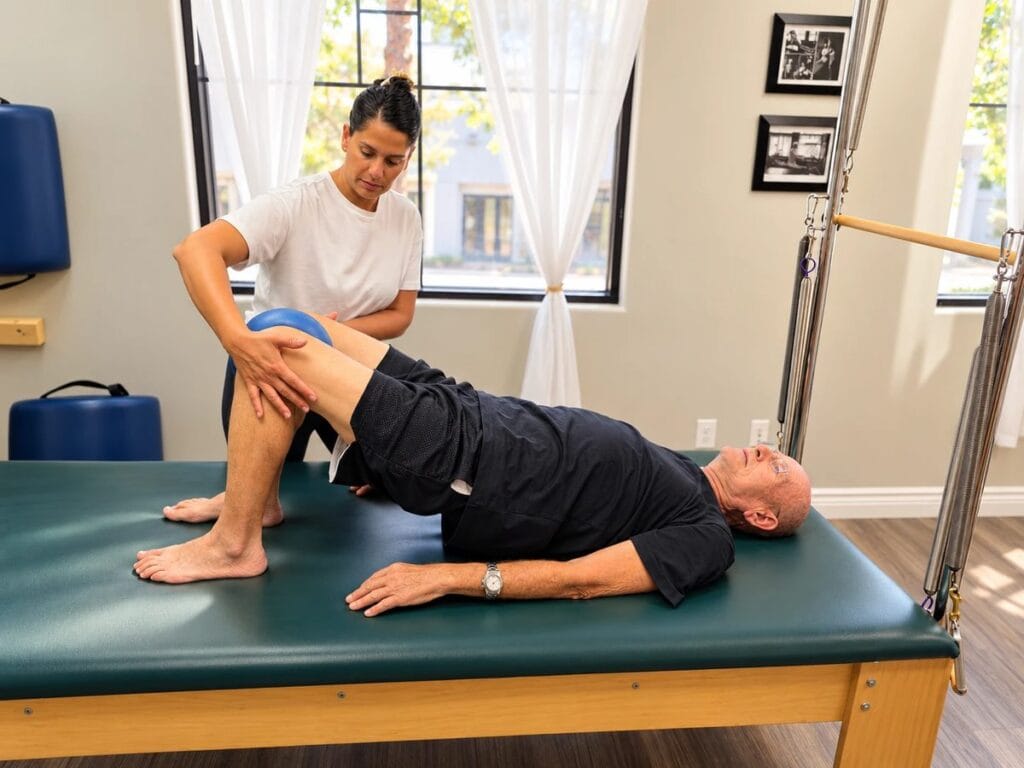
Is Pilates Good for Seniors? Here Is What Changes
Four things improve, and they happen to be the four that decide whether an ordinary day feels comfortable.
A 2021 meta-analysis in the journal Physiotherapy pooled 39 trials of adults aged 60 and over. Compared with control groups, Pilates produced moderate improvements in balance, muscular strength, flexibility and functional performance. The strongest and most confident finding was for strength.
Those are not abstract scores. Steadier, stronger and more mobile is the difference between a curb you think about and a curb you step off without noticing, and between a grab rail you need and one that is simply there. That is what the hour buys you.
Steadier and stronger is still worth a great deal on its own.
Free first session, no conditions
Book your free first session
One instructor, one client, a full hour. Leave your details and Rachel will call you to pick a time.
Rather talk now? Call (702) 848-4767
Balance Is the One That Matters Most
Balance is not one skill. Standing still on a flat floor is one thing. Turning to close a cabinet while holding a plate is another, and that second kind is where confidence actually lives.
Balance is not one skill. Standing still on a flat floor is one thing. Turning to close a cabinet while holding a plate is another, and that second kind is where confidence actually lives. Both improve with Pilates, and the moving kind, which is the kind that counts, improves more. I wrote about how to train it in Pilates for balance: how to get steady on your feet again.
Both kinds improve with Pilates, and the research on dynamic balance, the moving kind, is the stronger of the two. In a private hour I can pick exactly where on that scale to work. Someone who feels unsteady starts with their hands on something solid and the apparatus doing part of the job. We take the support away in stages, and usually the person notices the change outside the studio before they notice it inside it.
That is the honest measure. Not whether you can hold a position in front of me, but whether the curb stopped being a decision.
Strength That Shows Up in Real Life
Muscle gets harder to keep after 60, particularly without resistance work. It shows up in specific places: standing up from a low chair, the last few stairs, carrying one bag of groceries from the car instead of two.
Pilates apparatus runs on springs, and springs are adjustable in small increments. That matters more than it sounds. I can give a leg press a load that is genuinely demanding for the person in front of me without ever asking them onto the floor or under a barbell. Springs also do the thing nobody mentions: they can carry part of your weight, so you perform a movement you could not manage unaided and still get stronger from doing it. That is why a woman of eighty can train properly in this studio. No mat class can offer her the same hour.
I also think older clients are routinely under-challenged, and it bothers me. Gentle is not a goal. If the work never asks anything of you, your body has no reason to change. The job is to find the level that is demanding and appropriate at the same time, which is a different thing from easy.
So the exercises I choose get pointed at the movements you actually do. Hips, legs and trunk, organised around standing up, walking and staying upright when something unexpected happens.
Mobility You Can Use
Stiffness is the complaint I hear most and the one people most expect to be permanent. Flexibility does improve in older adults who do Pilates, and it was one of the four outcomes that improved in the 2021 review.
I do not treat range of motion as a score, though. Nobody needs a flat split. One person needs a shoulder that reaches the top shelf. Another needs a hip that lets them get socks on without sitting down first. Those are the targets, and they are different for every client.
Why I Teach Older Clients One to One
Group classes work well for plenty of people. They stop working the moment the room contains two bodies with genuinely different needs, which is almost guaranteed once you are past 65.
Two 72-year-olds can be nothing alike. One hikes at Red Rock on Saturdays. The other has a replaced knee, a shoulder that does not like overhead work and a balance problem she has not told anyone about. Putting them through the same sequence serves neither.
In a private session every variable moves: the exercise, the spring load, the range, the speed, the position, the rest, how much balance challenge is in it. Nothing is a compromise with somebody else’s hour. If you want the longer comparison, I wrote one on private versus group Pilates.
There is also a plainer reason. In a class of twelve, nobody is watching your knee. I am watching your knee.
In a private hour nothing is a compromise. The first one is free, and there is nothing to cancel.
Can You Start Pilates at 70 or 80?
Yes. I have started people in their eighties who had not done structured exercise in forty years.
Age is not the variable that decides this. Health history is, along with current activity, medication, balance, and what you want out of it. Someone starting at 75 needs a different first month than someone who has trained continuously since their forties, and that is not a judgement about either of them.
What I will say is that beginners should not be measured against anyone else. There is no standard you are behind on. If you are dealing with a recent surgery, an unexplained symptom, a significant balance problem or a condition your physician is actively managing, get cleared first. That is a short conversation with your doctor, not a barrier.
If you are in your fifties rather than your seventies, the emphasis shifts, and I covered that separately in what changes in a Pilates practice after 50.
What Your First Session Actually Looks Like
You do not need experience. You do not need to be flexible. You do not need special clothing beyond something you can move in.
The first part is conversation and watching. What you do in a normal week, what hurts, what you have had done surgically, what you stopped doing and would like back. Then I watch you stand up, sit down, walk and reach, because that tells me more in two minutes than a questionnaire does in ten.
After that we get on the apparatus. The Reformer is where most older beginners start, because lying down removes the balance problem entirely while the springs still make you work. The Cadillac has a frame you can hold, which makes it the safest place to introduce standing work. The Wunda Chair is where we build the actual sit-to-stand. The small barrel opens a stiff upper back without asking you to get down onto a mat.
The apparatus is not what makes an exercise safe or useful. The choice is. A Reformer can be gentle or brutal depending on the springs and who set them. You can see the whole studio if you want to know what you are walking into.
Progress also does not always mean heavier. Sometimes it means the same exercise with control you did not have in March.
That is what a first session looks like, and it costs nothing. Leave your details and Rachel will call you to pick a time.
Seniors With Lower Back Pain
Pilates has been studied for low back pain more than for anything else, and it does well. A network meta-analysis in the Journal of Orthopaedic and Sports Physical Therapy set the main exercise approaches against each other and ranked Pilates first, for pain and for disability both. A second analysis in the same journal two years later landed in the same place. Back pain does not all have one cause, which is why your plan has to come out of an assessment rather than off a list.
Which is roughly what I would expect. Not all back pain has the same cause, so no single exercise plan can be the answer for all of it. What my physiotherapy background changes is where I look. Rather than treating the sore spot as the whole story, I look at hip mobility, trunk control and how the load is being distributed when you move.
Pilates sits alongside medical care, never instead of it. New pain, severe pain, pain that is getting worse, or pain with numbness, weakness or bladder changes needs a physician first. There is more detail on Pilates for back pain if that is your main reason for looking.
How Often, and What Else You Need
One or two supervised sessions a week is a realistic start for most beginners. Consistency beats intensity by a distance at this stage.
But Pilates on its own is not a complete week. The CDC recommends that adults 65 and older get at least 150 minutes of moderate aerobic activity a week, muscle-strengthening work on two or more days, and activities that challenge balance.
Pilates covers the strengthening and the balance comfortably. It does not cover the aerobic part. Walk, swim, ride, do whatever you will actually keep doing, and let the studio handle the rest. I would rather you walked four times a week and saw me once than the other way around.
Common Questions
What type of Pilates is best for seniors?
Apparatus-based Pilates taught one to one, in most cases. Springs let the resistance be adjusted precisely, and lying or seated positions remove the balance demand until you want it there. Mat work is valuable too, but getting down to and up from the floor is itself a barrier for some people, so it is often something we build towards rather than start with.
Can a 70 year old do Pilates?
Yes, and so can an 85 year old. The exercises get selected for the person. What needs checking first is not your age but any recent surgery, unmanaged medical condition or significant balance problem, and that check belongs with your physician.
Is Reformer Pilates safe for seniors?
Yes, and it is where I start most older beginners, because you are supported and the load adjusts in small steps. What makes it safe is the selection and the supervision rather than the machine itself, which is the argument for having the hour to yourself.
Does Pilates prevent falls?
It trains the thing that keeps you upright. Balance is a skill, it responds to practice, and in a private hour I can put the balance challenge exactly where you can handle it today and then move it as you improve. The longer answer is in Pilates for balance.
Will Medicare pay for Pilates?
Original Medicare does not cover Pilates. Some Medicare Advantage plans include a fitness benefit such as SilverSneakers, Renew Active or Silver and Fit, and those generally apply to participating gyms rather than independent private studios. Swan Pilates is independent and is not in those networks, so sessions here are paid directly. Check your plan’s summary of benefits if you are unsure.
Do I need to be flexible before I start?
No. That is like saying you need to be clean before a shower. Flexibility is one of the things the work is for, and every exercise can be scaled to the range you have today.
What does private Pilates for seniors cost in Las Vegas?
Your first private session is free, with no conditions attached and nothing to cancel. After that it depends on how often you come, and I would rather tell you a real number once I know what you actually need. Call and ask.
Private Pilates for Seniors in Summerlin and West Las Vegas
The studio is on West Sahara Avenue, a short drive from Summerlin and from Sun City Summerlin, and it is open seven days a week from 8:00 AM to 8:00 PM. Every session is private. There is no class running in the next room and nobody waiting for your machine.
If you are new to this, coming back after a long gap, or simply want to keep what you have for as long as possible, the place to start is finding out where your body actually is today. Not where it was at 40, and not where a chart says it should be.
Your first private session at Swan Pilates Las Vegas is free, with no conditions attached. Call 702-848-4767 or send me a note and tell me what made you start looking. If you want the wider picture first, here is everything I teach.
Swan Pilates Las Vegas, 8683 W Sahara Ave, Suite #240, Las Vegas, NV 89117.
Mentioned above: the Reformer, the Cadillac, the Wunda Chair and the small barrel. You can see the whole studio and every piece of apparatus I teach on.