
Yes. Pilates for physical rehabilitation can be genuinely valuable, and there’s a reasonable body of research behind that. But the answer comes with a condition attached, and the condition is really the whole story: the work has to be chosen for the person in front of you.
When I talk about rehabilitative Pilates, I’m not describing a set of exercises. I’m describing what happens before any exercise gets chosen at all.
How does this person move? Where are they weak, and where are they restricted? Are they compensating for a limitation somewhere else in the body? What have they quietly stopped doing because it hurts?
Once I have answers to that, Pilates gives me an unusually wide set of tools to work with: strength, mobility, stability, coordination and movement control, all of which can be progressed gradually as someone’s capacity changes. That range is a large part of why I think the method suits rehabilitation as well as it does.
Why Pilates Suits Rehabilitation Work
Most exercise is organized around an outcome. Get stronger. Get more flexible. Improve your cardiovascular fitness.
Rehabilitation asks a different question. It asks how the body is actually functioning, and where that function has broken down.
Take someone who comes to me with lower back pain. Strengthening the back may not touch the reason they’re struggling. There may be weakness through the abdominals. There may be restriction somewhere else entirely, at the hip or through the upper back. Certain muscles may have shortened over time. And almost always, the person has built compensations around the problem without ever noticing they were doing it.
Pilates lets me work on those things together rather than one at a time. Depending on the person, a rehabilitative program might be built around:
- Core and trunk strength
- Stability and movement control
- Mobility and flexibility
- Balance and coordination
- Correcting habitual movement patterns
- Rebuilding strength after a period of inactivity
- Restoring confidence in movement
- Getting back to specific everyday activities
None of that is decorative. Every exercise in a program should be there for a reason I can state out loud.
What the Research Actually Shows
Lower back pain is where Pilates has been studied most thoroughly, and the picture is encouraging.
A 2024 systematic review that screened more than 1,500 records and included 36 studies found that Pilates reduced low back pain compared with no exercise, with a similar trend when it was compared against non-specific exercise. A separate network meta-analysis ranked Pilates highest among the exercise approaches it compared, for both pain and disability, in adults with chronic low back pain.
Broader guidance points the same way. The systematic review that informed the World Health Organization’s 2023 guideline on chronic primary low back pain concluded, with moderate certainty, that structured exercise programs probably reduce pain and functional limitations.
Now the part that tends to get left out.
The Cochrane review on Pilates for low back pain found low to moderate quality evidence that Pilates outperforms minimal intervention, but no conclusive evidence that it outperforms other forms of exercise. Studies also vary enormously in the programs they run, the people they recruit and how long they follow them.
So I’d put it this way. The evidence supports Pilates for physical rehabilitation as a strong option, particularly for chronic lower back pain. It doesn’t support the claim that Pilates is the best option for every person or every condition. What seems to matter more than the name of the method is whether the program genuinely fits the person doing it.
Why the Same Exercise Doesn’t Suit Everyone
This is where rehabilitative work parts company with a general Pilates class.
Picture ten people performing the same exercise. One of them needs more hip mobility before anything else will help. Another needs trunk stability. A third has plenty of strength but is producing the movement through the wrong pattern, borrowing from somewhere that shouldn’t be involved at all.
Give all three of them the same program and you’ve addressed one of them, possibly none.
Two people can walk into the studio describing the same problem in almost the same words and leave with completely different programs. That’s not inconsistency. That’s the whole reason for assessing first.
Why I Teach Rehabilitation One-on-One
For rehabilitation clients I’ll be blunt: I don’t think there’s a substitute for individual attention.
In a private session I can watch how someone actually performs each movement and respond to what I see. Is anything uncomfortable? Is another part of the body doing work it shouldn’t be? Does this person have enough control to perform the exercise properly, or are we asking too early? Should I take resistance off, or add support? Is it time to progress?
None of those questions can be answered while someone is trying to keep pace with a room. In rehabilitation, the progression has to follow the person, not the class.
How the Apparatus Changes What’s Possible
The other reason I like Pilates for this work is the equipment.
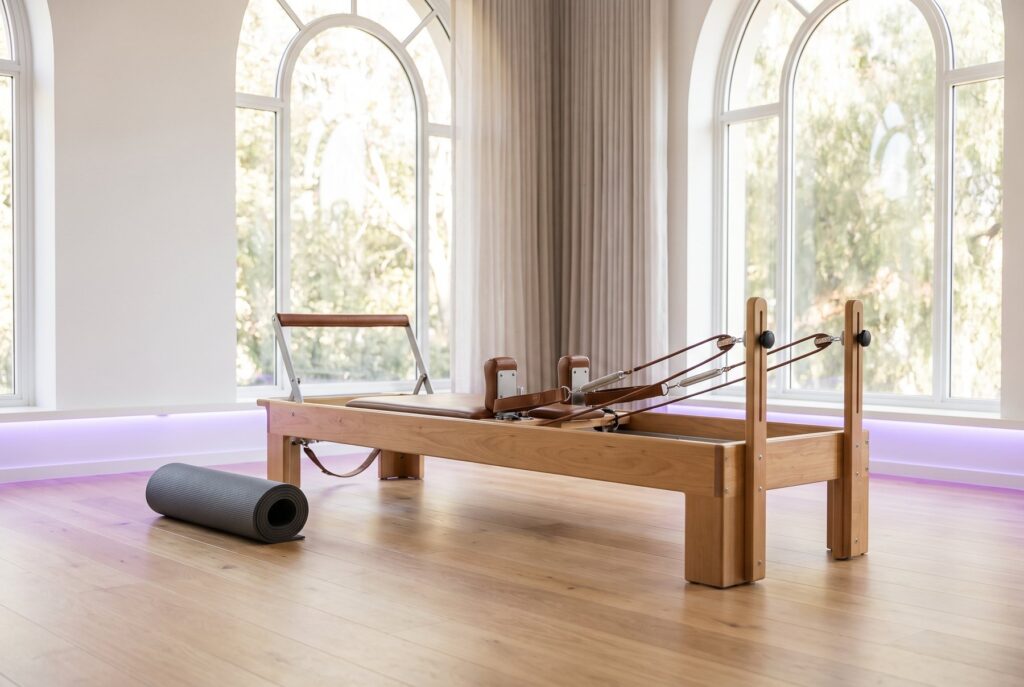
At Swan Pilates I have the Reformer, the Cadillac and the Wunda Chair, and I choose between them based on what I’m trying to achieve. What surprises most people is that the apparatus is often there to make a movement easier, not harder.
Springs and body position can assist a movement that someone can’t yet produce on their own. As control improves, I can change the resistance, the position, the range or the complexity of the exercise, and each of those is a separate dial I can turn.
That’s what makes gradual progression possible. Instead of jumping from an exercise that’s too easy to one that’s too hard, there’s a path between them. For someone rebuilding after a long stretch of pain or inactivity, that path matters as much as the exercises at either end of it.
A Case From the Studio
One example from my own work shows how this plays out.
A client came to me with chronic lower back pain. His job involved heavy lifting, and the pain had reached the point where it was interfering with his ability to work comfortably.
Rather than handing him a standard back-pain routine, I assessed him first. What that showed was weakness through the abdominal and pelvic floor muscles, along with shortened hamstrings and posterior calf muscles. Those findings set the direction of the entire program. We started simply, built the foundation, then progressed onto the apparatus as he became ready for it, with work to do at home between sessions. Over roughly three months his back pain resolved and he returned to work without limitation. I have written about that case in more detail here.
One person’s experience doesn’t predict anyone else’s, and I want to be careful about that. Results and timelines vary considerably. But the reason his program worked was the assessment that came before it.
Where Pilates Stops and Medical Care Begins
Rehabilitative Pilates is not physical therapy, and that distinction deserves to be stated plainly rather than blurred.
Pilates can form part of a rehabilitation strategy. It’s not a replacement for medical care. Injuries, unexplained symptoms, recent surgery and diagnosed conditions should be evaluated by an appropriate healthcare professional first, and there are plenty of situations where Pilates works best running alongside treatment someone is already receiving.
Knowing when exercise is appropriate, when it needs modifying and when someone should be sent back to their physician is part of working responsibly with rehabilitation clients. My physiotherapy education informs how I read a body and how I select the work. What I teach in the studio is Pilates.
Who This Work Tends to Suit
Depending on the individual and their medical situation, rehabilitative Pilates may be worth considering for people dealing with:
- Chronic or non-specific lower back pain
- Weakness following a period of inactivity
- Reduced mobility or flexibility
- Poor balance or coordination
- Difficulty controlling particular movements
- Musculoskeletal limitations
- A gradual return to activity after an injury
- Rebuilding strength and confidence in movement
“Depending on the individual” is doing real work in that sentence. A program that suits one person can be entirely wrong for someone else with what looks like the same problem.
So, Is Pilates Good for Physical Rehabilitation?
Yes, with the condition I started with. Chosen well, adapted to the individual and progressed sensibly, Pilates is one of the most useful tools I have.
It lets me work on far more than strength alone: mobility, stability, coordination, control, and the confidence to move without bracing for pain. The research supports it particularly well as an exercise option for chronic lower back pain.
But the method itself isn’t what does the work. Rehabilitation depends on understanding the person, identifying what actually needs to change, choosing exercises for a reason and adjusting the program as they progress.
That’s the thinking behind how I approach it. I’m not trying to make anyone better at Pilates. I want Pilates to make them better at moving through their own life.
If that’s what you’re looking for, start with a conversation.