
You can train your balance back. That is the part most people over sixty are never told, and it is the reason this studio exists.
If you have started holding the furniture, or you think twice before stepping off a curb, what you are feeling is not age arriving. It is strength, control and reaction time that have drifted, and all three answer to the right kind of work.
Balance is a trainable skill, not a fixed trait. Classical Pilates trains it directly: the springs let you work at a load your body can handle today, and the work gets harder as you get steadier. Progressive balance training of this kind is one of the few things shown to reduce falls in older adults, by around a quarter.
What changes when you train balance properly
Balance is not one ability. It is four, and every one of them responds to training.
Strength where balance actually lives. Staying upright is mostly a job for the hips, the ankles and the muscles along the spine. When they are strong, a stumble stays a stumble. Spring resistance loads exactly those muscles without pounding the joints the way free weights do.
A spine that still moves. Decades at a desk or behind a wheel take rotation and extension first. Getting them back changes how you turn to reverse the car, how you reach a high shelf, and how your body corrects itself when your weight shifts without warning.
Reaction, not only strength. Catching yourself is a timing problem before it is a strength problem. Slow, deliberate, controlled movement teaches the nervous system to find the correction sooner, and that stays trainable at any age.
Confidence you have actually earned. People who stop trusting their balance move less, and moving less costs them the strength that was keeping them steady. Breaking that loop is the change most clients notice first.
The evidence, in three lines
- Pilates improves both static and dynamic balance in older adults. That is the conclusion of a 2024 review pooling 39 studies and 1,770 people.
- Balance and functional exercise reduces the rate of falls by about 24 percent. Cochrane graded that high certainty, across 39 trials and 7,920 people.
- The US Preventive Services Task Force recommends exercise for adults 65 and over who are at increased risk of falling.
No trial has yet put classical Pilates on its own against fall counts. That is precisely why the sessions here are built to include the progressive, upright balance work the evidence does support, instead of leaving it to chance.
First session free
Find out where your balance actually is.
One hour, one to one, nothing to buy afterwards.
Why classical Pilates and not a mat class
Most of what is sold as Pilates in Las Vegas is a class: one sequence, one tempo, a room full of people. It is a reasonable workout. It is not what builds balance in a seventy-five-year-old.
The apparatus does what a mat cannot. Springs resist, and springs assist. That second word is the one that matters here. A spring can carry part of your weight so that you perform a movement you could not manage unaided, and still get stronger from doing it. Nothing in a mat class can do that.
The load changes inside the exercise. If the third repetition is harder than the first, I change the spring on the third repetition. In a class of ten, nobody can.
It is a system, not a playlist. The classical order was built so that each exercise prepares the next. Followed properly it covers the whole body inside an hour, which is why it has held up for a century.
One room, one person. You are not keeping up with anyone. For balance work that is not a comfort, it is the mechanism: the difficulty can sit exactly at the edge of what you can do, and that edge is where improvement happens.
What the hour actually works on
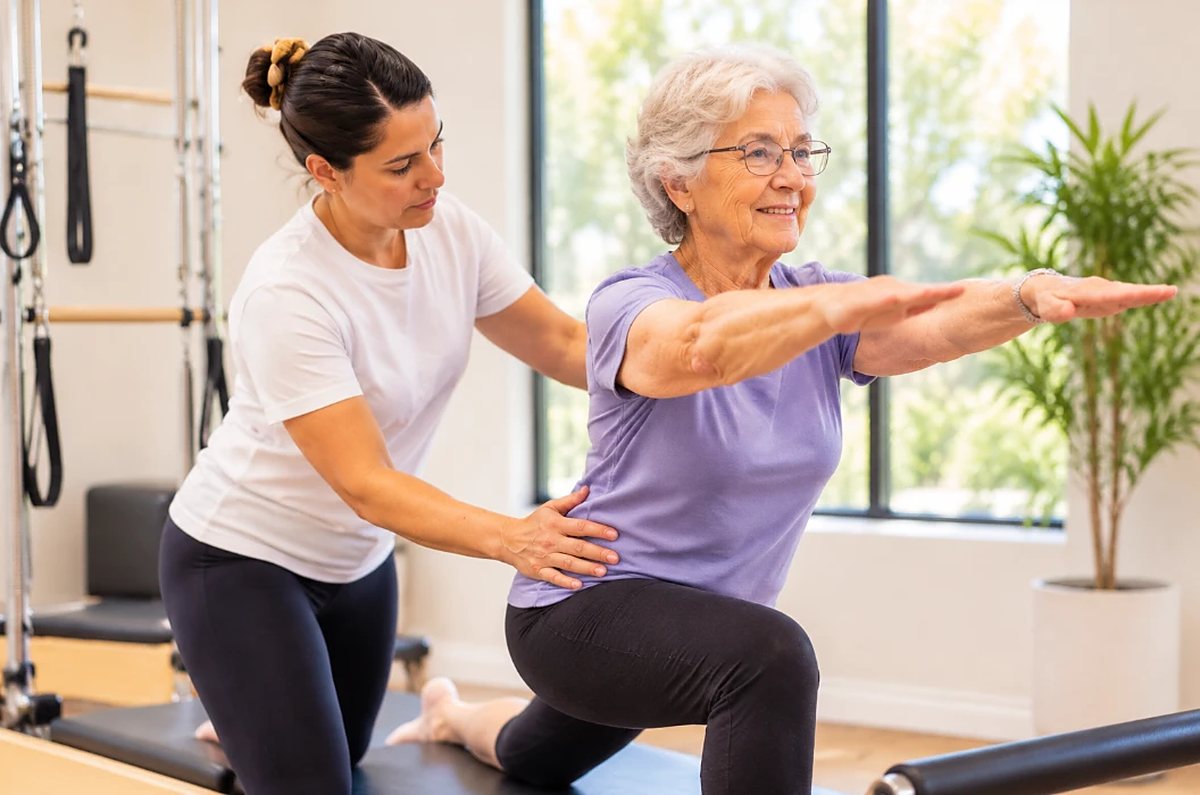
Standing and single-leg work happens mostly on the Wunda Chair and the barrels, both of which leave you something solid to hold while you learn. The Cadillac has a frame overhead, which is why people who do not yet trust their footing often start there. The Reformer builds the leg and trunk strength everything else rests on.
One thing I will tell you that a class never will: reformer work performed lying down is excellent for strength, and it is not balance training. Standing balance has to be trained standing. Part of your hour is spent on your feet.
What I check before we start
Some causes of falling are not reached by any exercise. Before building a program I ask about medications, your eyes, any dizziness, and the lighting and floors at home, because a medication review or a new prescription sometimes does more than a month of training would.
If you have fallen more than once, fainted, or noticed a sudden change in your balance, see your doctor first. I will say so plainly. I would rather lose the booking than have you train through something that needs looking at.
How often
Twice a week is where most clients settle at the start. The programs that worked in the research ran consistently over months, so what matters more than the number is that you keep coming.
The CDC asks adults over 65 for 150 minutes of moderate activity a week, strengthening on at least two days, and work that challenges balance. Two private sessions cover the strength and balance side comfortably. Walking covers much of the rest. There is more on the wider picture in my guide to private Pilates for seniors.
Common questions
Does Pilates prevent falls?
It makes you steadier, and steadiness is what keeps you upright. Balance and functional training of the kind a private classical session is built around has been shown to cut the rate of falls in older adults by about a quarter. No study has yet tested Pilates on its own against fall counts, which is exactly why I make sure that balance work is actually in your program rather than assumed.
Is Pilates good for balance after 70?
Yes, and the seventies and eighties are where it earns its keep. The research on Pilates and balance includes people in that range. Your starting point and your health matter far more than the number.
Is the reformer better than mat work for balance?
For most older beginners, yes, at the start. The reformer supports you while you build the strength to hold yourself up. But standing balance has to be trained standing, so a good program moves you onto your feet as soon as you are ready for it.
Can Pilates replace physical therapy for balance problems?
No, and it is not meant to. Repeated falls, unexplained dizziness or a sudden change in steadiness belong with a doctor or a physical therapist first. Pilates is what builds and then keeps the strength once you are cleared to work.
How soon will I notice a difference?
Most people notice the small things first: getting out of a chair without planning it, turning on the stairs without holding the rail. How quickly depends on where you start and how consistently you come.
Do I need any Pilates experience?
None. Most people who come to me for this have never done Pilates. The first session is a conversation and a look at how you actually move, before anything is decided.
Private Pilates for balance in Summerlin and Las Vegas
Every session here is one to one, in a private studio a short drive from Summerlin and Sun City Summerlin.
The first private session is free, with nothing to buy first. Come once, see how your body responds, and decide afterwards.
First session free
Your first private session is free.
No conditions. A full hour, one to one, on the full classical apparatus.