
If you’re comparing private vs. group Pilates, you’ve probably noticed that almost every studio has an opinion about which format is best. I’ll be upfront about mine.
At Swan Pilates in Las Vegas, every session is private and one-on-one. The studio has never offered a group class. That doesn’t mean I think group Pilates is wrong. A good group class can be an excellent choice for a lot of people.
But private and group Pilates aren’t the same experience, and the right choice depends far more on your body, your experience and your goals than on which format happens to be popular. For some people a group Reformer class is exactly what they need. For others, especially beginners, people coming back from injury or surgery, or anyone trying to change a specific movement pattern, individual attention makes a real difference.
And you don’t need to be injured to benefit from private Pilates. Many of my clients simply want to learn Classical Pilates properly, progress at their own pace and have every session built around their own body.
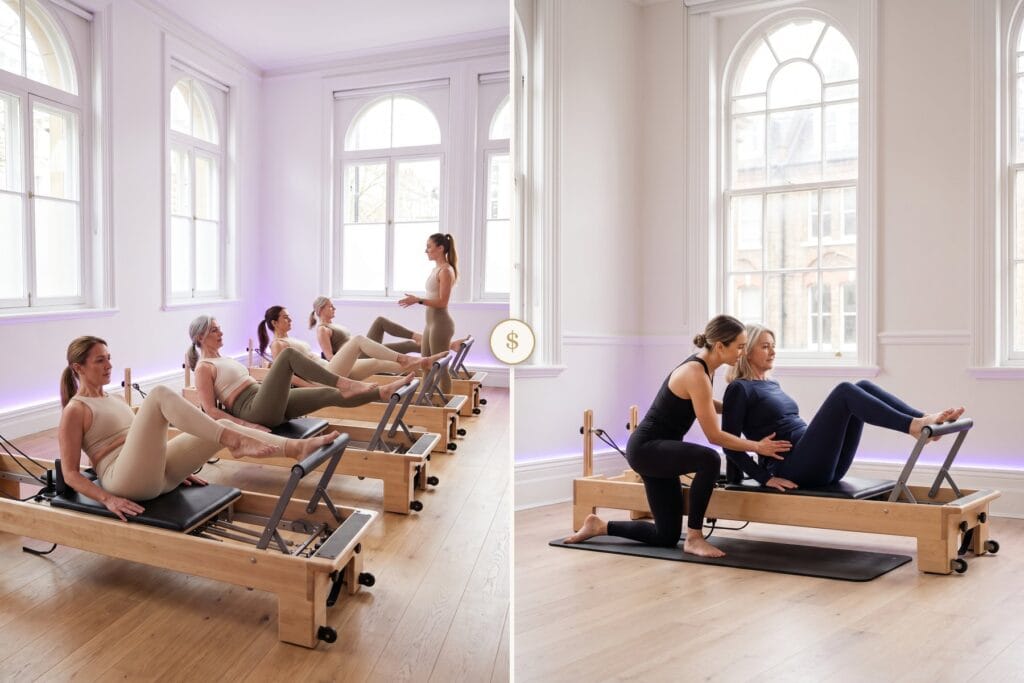
Private vs. Group Pilates: The Short Answer
If you’re healthy, already comfortable with the fundamentals and mainly want a regular, social and affordable workout, a well-run group class can serve you very well.
If you’re completely new to Pilates, dealing with back, neck, hip or shoulder discomfort, returning to exercise after surgery or injury, or you’ve tried group classes and felt lost or rushed, private Pilates is usually the better place to start. Private sessions are also valuable for healthy, experienced clients who want more precise instruction and faster progress through the Pilates system.
The biggest difference is simple. In a group class, you follow the class. In a private session, the session follows you.
| Private Pilates | Group Pilates | |
|---|---|---|
| Instructor attention | All of it, on every repetition | Shared across the room |
| Program | Built around your body and adjusted as you go | One sequence for the whole class |
| Pace | Yours | The class’s |
| Equipment | Full apparatus, chosen for you | Often Reformer only |
| Cost per session | Higher | Lower |
| Atmosphere | Quiet and private | Social and motivating |
| Best suited to | Beginners, injury or surgery history, precise individual progress | Healthy, experienced clients who want a regular, affordable workout |
What Actually Happens in a Group Pilates Class?
In a group class, one instructor leads several people through roughly the same sequence at roughly the same pace. That works well when everyone has enough experience to understand the exercises and adjust them sensibly.
Even an excellent instructor has practical limits, though. If one person has tight hips, another has an old shoulder injury and a third starts compensating through the lower back as an exercise gets harder, the instructor’s attention has to be divided among all of them. The cues also have to work for most of the room rather than for one particular body.
For someone who already knows the fundamentals and doesn’t need much modification, that may hardly matter. For someone learning Pilates for the first time, or working around a physical limitation, it can matter a great deal.
What Changes in a Private Pilates Session?
A private session begins before we start exercising. When someone first comes to Swan Pilates, I want to understand their history. Have there been injuries or surgeries? Is there recurring pain? Which movements feel difficult, and what does a normal day look like? Most importantly, what are they hoping Pilates will help them do?
Then I watch how they move: posture, breathing, control, mobility and the way different parts of the body work together. That tells me where we begin.
Every Repetition Gets Watched
One of the biggest advantages of one-on-one Pilates is that I can see every repetition. The difference between doing an exercise well and compensating is often tiny. A shoulder starts to lift. The pelvis rotates slightly. The lower back takes over work that should be coming from somewhere else, or the breath changes the moment the exercise gets challenging.
In a private session I can catch those changes as they happen and adjust straight away. Getting through the exercise was never the point. Understanding how your body is doing it is.
The Session Follows You
There’s no predetermined class to keep up with. If an exercise isn’t right for you that day, we change it. If you’re ready for more, we progress. If a particular limitation needs more attention, the whole session can change direction.
Two people can walk into the studio describing almost exactly the same problem and end up doing very different sessions. That’s one of the reasons I chose to teach one-on-one.
The Full Classical Pilates System
Many group studios are built mainly around the Reformer. It’s a wonderful piece of equipment, but it’s only one part of the Pilates system. In private sessions at Swan Pilates we work with the Reformer, Cadillac, Wunda Chair, barrels and mat, choosing whichever apparatus makes the most sense for the person and the exercise. You can see all of it on the studio page.
What surprises many new clients is that the equipment isn’t only there to make things harder. Springs, straps and the different apparatus can also support a movement, so someone can learn it with control before the body is asked to do more on its own. That’s a big part of what makes Classical Pilates so adaptable.
Private Pilates Isn’t Only for Injuries
People sometimes assume private Pilates is only for rehabilitation or for people in pain. It isn’t. I work with perfectly healthy clients who choose private sessions because they want to learn Pilates at a deeper level.
When the instructor is watching only you, there’s no waiting for the rest of a class. We can spend more time on what your body needs and less on what you’ve already mastered, and the work progresses as your strength, control and understanding grow. For anyone interested in learning the method rather than just completing a workout, that individual progression is hard to get any other way.
Where Group Pilates Classes Make Sense
I’d be doing you a disservice if I pretended group Pilates didn’t have real advantages. It does.
Cost is the biggest one: group classes generally cost considerably less per session. Some people love the social side, and exercising alongside others can make a routine easier to keep. Scheduling can be convenient too, since larger studios often run classes throughout the day. And if you already have solid fundamentals and no physical issues that need individual modification, a good group class is an excellent way to keep a regular practice going.
If you choose group Pilates, look for:
- Reasonable class sizes
- A well-trained instructor
- Attention to form, not just moving quickly through exercises
- A studio that asks about injuries and relevant health history
- An environment where modifications are encouraged when you need them
There’s also no reason you can’t combine the two. Some people build their foundation in private sessions and later add group classes as another way to keep moving.
Who Should Consider Starting With Private Pilates?
Private Pilates tends to be especially useful for:
- Complete beginners who want to learn the fundamentals with individual instruction
- People dealing with recurring back, neck, shoulder, hip or joint issues
- Anyone returning to exercise after an injury or surgery, once they have appropriate medical clearance
- People who need exercises modified around their own movement limitations
- Anyone who tried a group class and felt rushed, confused or unseen
- Clients who want to learn the complete Classical Pilates system
- Healthy clients who want precise instruction and faster individual progress
- People who simply prefer exercising in a quiet, private space
For adults whose bodies or exercise needs have changed over time, individual pacing can help too. I’ve written more about that in why your practice should feel different at 50 than at 30.
What About Pilates for Back Pain?
This is one area where individual attention deserves particular weight.
A systematic review published in PLOS ONE found that Pilates gave greater short-term improvements in pain and functional ability than usual care or general physical activity in people with chronic low back pain, while results were broadly equivalent to other forms of exercise. A more recent 2024 systematic review and meta-analysis also found that Pilates can reduce low back pain.
Those same reviews also make clear that no single exercise approach suits everyone, and that’s something I see in the studio all the time. When pain or a complicated movement history is involved, what matters most is understanding what your particular body is doing, and that’s very hard to do from across a room full of people. If that’s your situation, I’ve written more about Pilates for physical rehabilitation, and about how I work with back pain in Las Vegas.
A Real Example From My Private Pilates Work
One client came to me with chronic lower back pain after years of heavy physical work. Instead of starting him on a standard series, I first looked at how his body was functioning, and found weakness through the abdominal and pelvic floor muscles along with tight hamstrings and calves. That became our starting point. We built strength and control, gradually improved mobility, used the Reformer, Cadillac and Wunda Chair as the work required, and he practiced at home between sessions.
After about three months of consistent sessions and home practice, his back pain had resolved and he was back at work without pain. I’ve described that case in more detail here. One person’s experience doesn’t guarantee the same result for anyone else. What it shows is why I value individual work: his program didn’t come from whatever workout was scheduled for that hour. It came from what I saw in the person in front of me.
How My Physiotherapy Training Shapes the Way I Teach
Before Pilates, I worked as a physiotherapist for more than ten years, helping people recover from injuries and surgeries and working with chronic pain. That work taught me how much depends on watching one person closely: where a movement is really coming from, the small compensations, and when to progress or slow down.
When I discovered Classical Pilates, that attention to the individual made immediate sense. Pilates gave me an extraordinary system for building strength, control, mobility and awareness, and I never lost the habit of looking at the person before looking at the exercise. What I teach in the studio is Pilates, not physiotherapy, but that background is the reason Swan Pilates became a private studio rather than a group one. I want enough time and attention to understand the person I’m teaching.
If you’d like to know more about the method itself, here’s what Classical Pilates means and how it differs from many modern classes.
Is Private Pilates Worth the Extra Cost?
Private Pilates costs more per session than group Pilates. There’s no point pretending otherwise. But you’re paying for something fundamentally different.
The instructor’s attention isn’t divided between five, ten or fifteen people. The session adapts continuously. You don’t wait for the class to progress, you don’t do an exercise just because everyone else is, and if something isn’t working, we stop and figure out why.
If all you want is an affordable weekly workout, that extra attention may not be necessary. If you want to learn Pilates properly, progress individually, work around a physical limitation or understand how you move in real detail, the value looks very different.
Many clients at Swan Pilates start with two or three private sessions a week to build consistency and a solid foundation. From there we adjust the frequency to their goals, schedule and progress.
Private or Group Pilates: How Do You Decide?
Ask yourself four questions:
- Do I have pain, an old injury, a surgery history or another limitation that may need individual modifications?
- Do I understand the fundamentals well enough to know when I’m doing an exercise correctly?
- Am I mainly after a convenient workout, or do I want to change something specific about the way my body moves?
- Would I enjoy the energy of a group, or would I rather have the instructor’s complete attention?
If you’re healthy, experienced and enjoy exercising with other people, try a good group class. If you’re new, unsure about how you move, working around an injury or looking for a truly individual practice, start private. You can always move into group classes later, and you’ll do it with a much better understanding of the method and of your own body.
Private Pilates in Las Vegas and Summerlin
Swan Pilates is a private, one-on-one Pilates studio serving Summerlin, Henderson and the wider Las Vegas area. Every session is taught individually, so there’s no class to keep up with and no standard workout that everyone gets.
Whether you’re after one-on-one Classical Pilates, individual exercise after an injury, or simply a more personal way to practice, the first step is working out what you’re looking for and whether my approach suits you. You can read more about private Pilates sessions in Las Vegas, or contact me to talk about your goals.
Mentioned above: the Reformer and the Wunda Chair. You can see the whole studio and every piece of apparatus I teach on.